

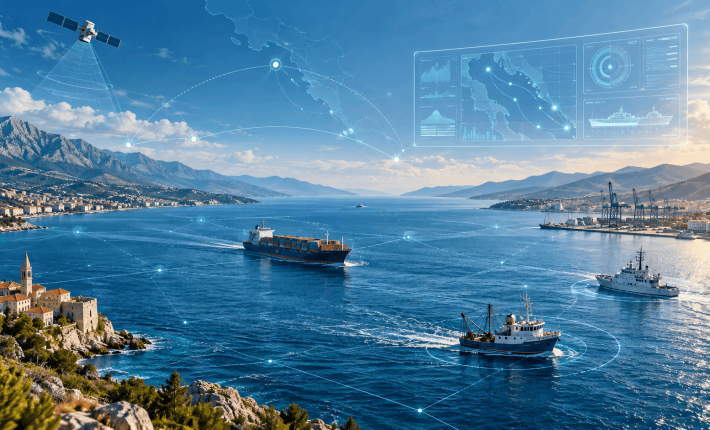
Artificial intelligence is opening new opportunities for maritime governance and its greatest potential may lie in something less visible: making cooperation between institutions, countries and regulatory systems more effective.
The challenge: making the invisible visible
How much do we really know about what happens at sea?
According to a study published in Nature in 2024, between 72% and 76% of the world’s industrial fishing vessels were not publicly tracked during the period analysed.
Researchers revealed a significant gap between actual maritime activity and what existing monitoring systems could observe thanks to the combination of satellite imagery, vessel positioning data and deep learning.
This finding highlights one of the fundamental challenges of maritime governance: authorities cannot effectively manage what they cannot see.
Maritime governance faces a key challenge: managing complex, cross-border activities with fragmented information. AI helps bridge these gaps by integrating data, identifying patterns, anticipating risks and supporting more informed, coordinated decision-making across authorities.
In other words, AI can help transform maritime data into actionable intelligence.
Five ways AI is transforming maritime governance
1. Improving maritime visibility and monitoring
Traditional vessel-tracking systems, such as the Automatic Identification System (AIS), provide valuable information but do not offer a complete picture of maritime traffic.
AI-powered analysis of satellite radar imagery can identify vessels that are not visible through publicly available tracking systems, helping authorities detect potentially suspicious activities and better understand the distribution of maritime operations.
2. Strengthening maritime security and early warning
AI can also improve the ability of maritime authorities to identify unusual patterns and respond to emerging threats.
By analysing maritime data, AI-supported systems can help detect anomalies, flag potentially suspicious behaviour and provide earlier warnings.
In October 2026, the United Nations Security Council placed emerging technologies and maritime security at the centre of a high-level discussion initiated by Greece.
The challenge is therefore twofold: using AI to improve security while ensuring that the technologies themselves remain secure, reliable and accountable.
3. Connecting fragmented maritime data
The European Maritime Safety Agency (EMSA) has already demonstrated how AI can help overcome limitations given by large volumes of data originating from different systems, often using inconsistent formats, terminology and reporting procedures.
In cooperation with Frontex, EMSA introduced a pilot service using Natural Language Processing (NLP) to convert free-text port destinations reported through AIS into standardised international location codes.
This improves the consistency of vessel information and supports more accurate monitoring and analysis.
4. Supporting decisions through digital twins
AI is also helping maritime authorities move from observing current conditions to anticipating future scenarios.
Digital twins create virtual representations of physical environments by combining real-world observations, historical information and simulation models.
They can help decision-makers explore potential developments involving ocean currents, marine ecosystems, coastal risks and economic activities.
Europe’s Digital Twin Ocean is a significant example.
According to the Flanders Marine Institute (VLIZ), AI-driven models integrated into the initiative have improved ocean current prediction accuracy by more than 20%.
For public authorities, these technologies offer opportunities to assess different scenarios before implementing policies or interventions, supporting more informed and sustainable decisions.
5. Supporting the governance of autonomous maritime operations
In May 2026, the International Maritime Organization (IMO) adopted its first global safety code for Maritime Autonomous Surface Ships (MASS).
The code establishes a framework for the safe operation of autonomous and remotely controlled cargo vessels.
It addresses issues including navigation, remote operations, cybersecurity and safety, while maintaining human accountability.
From global challenges to the Adriatic: the BlueGovAI project
An important challenge concerns the administrative and regulatory barriers that can limit cooperation between neighbouring countries in the Adriatic Sea.
Italy and Croatia share maritime activities, environmental interests and opportunities for sustainable blue economy development.
Cooperation can become complex, particularly for smaller organisations due to differences in national regulations, administrative procedures and institutional responsibilities
This is the challenge addressed by BlueGovAI – Enhancing Cross-Border Governance through AI for a Sustainable Blue Economy.
Co-funded by the European Union through the Interreg Italy–Croatia Programme, BlueGovAI runs from February 2026 to July 2027 and brings together Cooperativa Sociale Odòs, as Lead Partner, Quantitas and the Development Agency of the Municipality of Orebić (ORA).
The project aims to reduce legal and administrative barriers to cross-border cooperation through practical, AI-supported solutions.
Its approach focuses on making regulatory information more accessible, understandable and useful for public authorities, small ports, local stakeholders and SMEs operating in the blue economy.
Among the planned solutions are:
- An AI-supported dashboard designed to identify differences, overlaps and potential inconsistencies between Italian and Croatian maritime regulatory frameworks.
- A multilingual question-and-answer assistant to help users navigate relevant regulations, identify competent authorities and access the underlying legal sources.
- Practical tools, including regulatory gap analysis and checklists, to help smaller organisations better understand cross-border administrative requirements.
- Ethical guidelines and stakeholder engagement activities to promote responsible AI adoption.
Within the partnership, Quantitas contributes its expertise in data intelligence, AI integration and the development of digital tools supporting evidence-based decision-making, with particular attention to responsible AI governance.
An important component of the project is understanding the actual needs of maritime stakeholders.
BlueGovAI includes a cross-border survey and 20 semi-structured interviews involving public authorities, experts and blue economy operators. These activities help identify practical challenges and inform the development of solutions aligned with real operational needs.
The project’s underlying principle is clear: AI should make complex information easier to access and interpret, without replacing the institutions responsible for applying the law since its outputs will remain subject to human verification.
This approach reflects a broader vision of AI as an enabler of institutional cooperation rather than a substitute for public decision-making.
Cooperation is already happening: technology can take it further
In September 2026, maritime authorities from Italy, Croatia and Slovenia participated in a joint search and rescue exercise in the Gulf of Trieste, involving EMSA, Frontex and the European Fisheries Control Agency.
The exercise demonstrated the importance of coordinated procedures, information exchange and cooperation between national authorities when responding to maritime emergencies.
BlueGovAI applies a complementary principle to administrative and regulatory governance.
Just as maritime authorities need interoperable communication systems to coordinate operational responses, public institutions and economic operators need accessible, consistent information to navigate cross-border rules.
AI can help bridge this gap, making regulatory complexity more manageable and facilitating more effective cooperation.
Responsible AI: why human oversight remains essential
A 2026 study by Thetius and Marcura illustrates the gap between AI adoption and organisational readiness in the maritime sector.
According to the research:
- 63% of maritime professionals use AI daily.
- Only 8% consider their organisation’s AI governance mature.
- 55% spend at least one hour per week checking or correcting AI-generated outputs.
- 80% believe that a named person should always remain accountable for commercial decisions.
These figures reveal a critical issue: technological adoption is progressing faster than the frameworks needed to ensure reliability, transparency and accountability.
In maritime governance, where decisions may affect public safety, environmental protection and economic activities, these considerations are especially important.
AI-generated information must be verifiable. Data sources should be identifiable. Responsibilities must remain clearly defined.
The European regulatory framework is also evolving. Under the EU AI Act and the amendments introduced through the Digital Omnibus, specific obligations for certain high-risk AI systems will apply according to phased implementation deadlines.
However, responsible AI should not be treated simply as a future compliance requirement.
Projects such as BlueGovAI demonstrate the importance of incorporating transparency, human oversight and clearly defined decision-making responsibilities from the design stage.
Towards a more connected and sustainable maritime future
The future of maritime governance will depend not only on technological innovation, but also on the ability of institutions to cooperate across borders, share reliable information and translate data into effective decisions.
This is becoming increasingly relevant as international commitments to ocean protection evolve.
The entry into force of the United Nations High Seas Treaty in January 2026 represents an important step towards stronger protection of marine biodiversity beyond national jurisdiction. Its implementation will require effective international cooperation, scientific information and monitoring capabilities.
AI can support these efforts by improving maritime visibility, connecting fragmented information and helping authorities anticipate the consequences of different decisions.
Through initiatives such as BlueGovAI, Cooperativa Sociale Odòs, Quantitas and the Development Agency of the Municipality of Orebić (ORA) are contributing to this transition, exploring how AI and data intelligence can help make maritime governance more accessible, coordinated and effective.
Sources and further reading
Nature, 2024 — https://www.nature.com/articles/s41586-023-06825-8
Security Council Report, 2026 — https://www.securitycouncilreport.org/monthly-forecast/2026-10/emerging-technologies-and-maritime-security.php
EMSA – AI applications in IMS — https://www.emsa.europa.eu/newsroom/latest-news/item/5044-another-step-in-the-development-of-ai-applications-in-ims.html
VLIZ – Digital Twin Ocean, 2025 — https://www.vliz.be/en/news/europe-showcases-ai-powered-digital-twin-ocean-major-outcome-european-ocean-pact
European Commission – OceanEye, 2026 — https://commission.europa.eu/news-and-media/news/oceaneye-placing-eu-forefront-ocean-observation-2026-06-03_en
IMO – MASS Code, 2026 — https://www.imo.org/en/mediacentre/pressbriefings/pages/imo-adopts-mass-code.aspx
Interreg Italy–Croatia – BlueGovAI — https://www.italy-croatia.eu/web/bluegovai
EMSA – Gulf of Trieste exercise, 2026 — https://www.emsa.europa.eu/newsroom/latest-news/item/5833-joint-search-and-rescue-exercise-in-the-gulf-of-trieste-under-mmo-adria-2026.html
Marine Insight – AI governance in maritime, 2026 — https://www.marineinsight.com/63-of-maritime-professionals-use-ai-daily-but-only-8-report-mature-governance/
European Commission – AI Omnibus — https://digital-strategy.ec.europa.eu/en/news/ai-omnibus-enters-force
United Nations – BBNJ Agreement — https://www.un.org/bbnjagreement/en

